Yen at 40-Year Lows: Trading USDJPY Under Intervention Watch
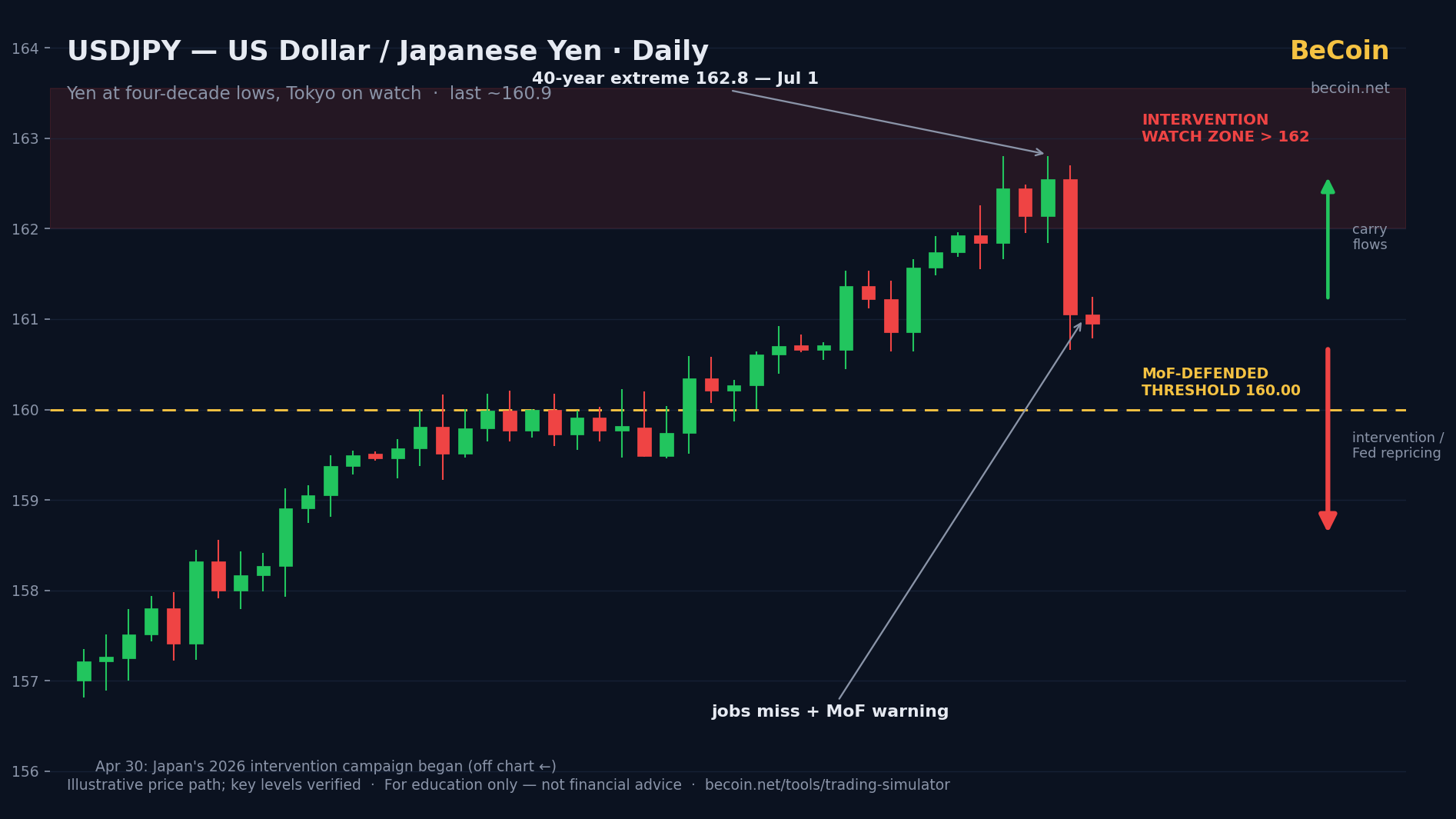
There are trends, and then there is USDJPY in 2026. The pair pushed to about 162.8 this week — the yen's weakest level in roughly four decades — before snapping back below 161 in two sharp sessions. The reversal had two authors: a shock US jobs report that softened the dollar everywhere, and Japan's Finance Minister Satsuki Katayama reminding markets that Tokyo stands ready to intervene "at any time."
That combination — a parabolic trend, a government openly preparing to fight it, and a macro catalyst that just blinked — makes USDJPY the most dangerous and most watched chart in currency markets right now.
The Setup
The yen's decline is rooted in the interest-rate gap. Even after the Bank of Japan's tightening steps — most recently June's hike to 1.00%, its highest policy rate since 1995 — Japanese rates remain far below US rates, making the yen the funding currency of choice and USDJPY a magnet for carry traders. A hawkish Fed under Chair Kevin Warsh kept that spread wide all year.
Tokyo has not been passive. Japan's 2026 intervention campaign began with an operation on April 30, and for weeks afterward the pair hovered around the 160 threshold — a level analysts describe as actively defended rather than merely psychological. But late June brought a fresh push higher, culminating in this week's 162.8 print. Then came the July 2 jobs miss (57K vs ~110K expected), a near-1% yen rally toward 161, and further gains past 161 on July 3 as Katayama repeated her warning. Adding menace: reporting suggests Japan may stop telegraphing interventions in advance, aiming to catch speculators off guard.
Key Levels to Know
- 162.8 — this week's high and the yen's four-decade extreme; the zone above it is where intervention risk is most acute.
- 160.8 — the week's low after the two-day yen rebound.
- 160.00 — the defended threshold. It capped the pair for weeks and is now the level bulls need to hold on any deeper pullback — and the level bears want to see break to confirm a turn.
- 165 — the next big psychological marker if the trend resumes; most analysts assume Tokyo would act well before it.
The Bullish Case (for USDJPY)
Carry doesn't care about speeches. As long as the US-Japan rate differential stays wide, every dip in USDJPY gets refilled by yield-seeking flows — that has been the whole story of the trend. Bulls note that verbal warnings have come for months while the pair kept climbing, and that even the April 30 operation bought only temporary relief. One weak US jobs print does not close a multi-percentage-point rate gap. In this reading, the pullback to 161 is routine positioning cleanup, and the trend resumes unless the Fed actually cuts.
The Bearish Case (for USDJPY)
Bears argue the risk-reward has flipped. The pair is stretched to a four-decade extreme, speculative long positioning is crowded, and the two forces that end such trends just showed up together: a US labor market cracking (which narrows the rate gap from the American side) and a finance ministry preparing unsignaled intervention (which punishes the crowd from the Japanese side). Intervention into an already-softening dollar is far more effective than intervention against a rising one — that is precisely the window Tokyo now has. A break back below 160 would trap late longs and could unwind weeks of carry accumulation quickly.
What Traders Should Watch Next
Intervention leaves footprints: sudden multi-yen drops in minutes, usually during Tokyo hours or illiquid periods — holiday-thinned trading like this week's is a classic window. Watch the 160 threshold on any continued slide; it separates "pullback" from "trend damage." On the macro side, every Fed communication and US data point now moves the rate-differential math, and any BoJ hint of faster tightening compounds it. Finally, watch for silence: if Tokyo's warnings stop, history suggests that is when action is closest.
Conclusion
USDJPY at 40-year extremes is a live experiment in what happens when a powerful trend meets a determined government. Both sides of the trade carry unusual risk — bulls face invisible intervention, bears face relentless carry flows. What is certain is that the zone between 160 and 163 has become one of the most consequential few yen in global macro, and the resolution will echo across every JPY cross.
This is exactly the kind of tape that punishes real-money experimentation. Test this setup in BeCoin's Trading Simulator: https://becoin.net/tools/trading-simulator — simulate an intervention-style shock candle and see how your stops and sizing hold up.
Related: Yen crosses topping first: GBP/JPY and CAD/JPY.
Risk note: This article is for information and education only and is not financial or investment advice. Currency intervention can cause extreme, discontinuous price moves with severe slippage; trading around such events carries elevated risk. Always do your own research and never risk money you cannot afford to lose.
---
Gold Blasts Past $4,100 After Jobs Shock: Breakout or Trap?
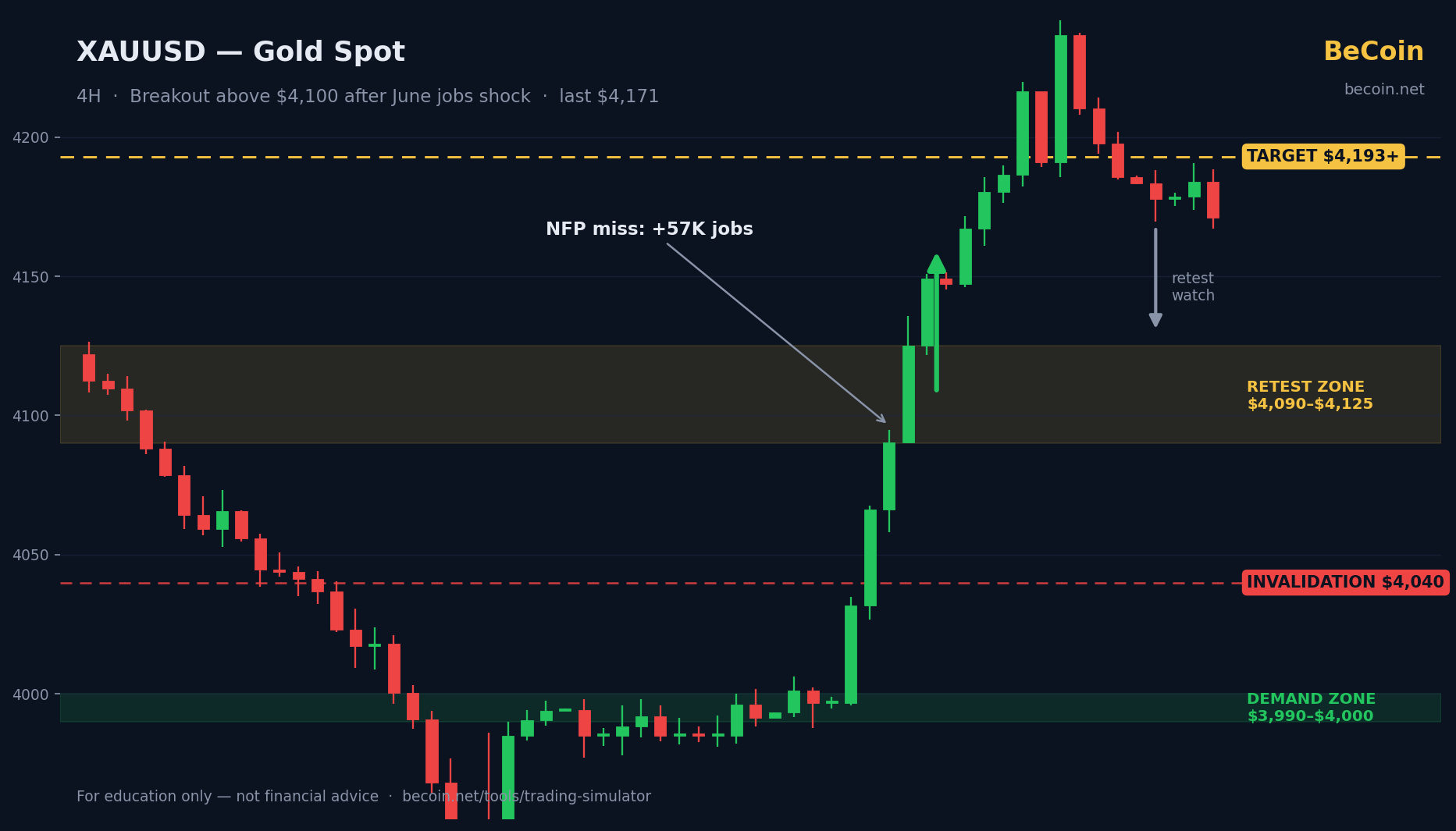
Gold surged past $4,100 after a shock US jobs miss. We map the key levels, the bullish and bearish cases, and what traders should watch next — plus how to practice the setup risk-free.
EURUSD Rebounds From One-Year Lows: Is the Dollar's Run Over?
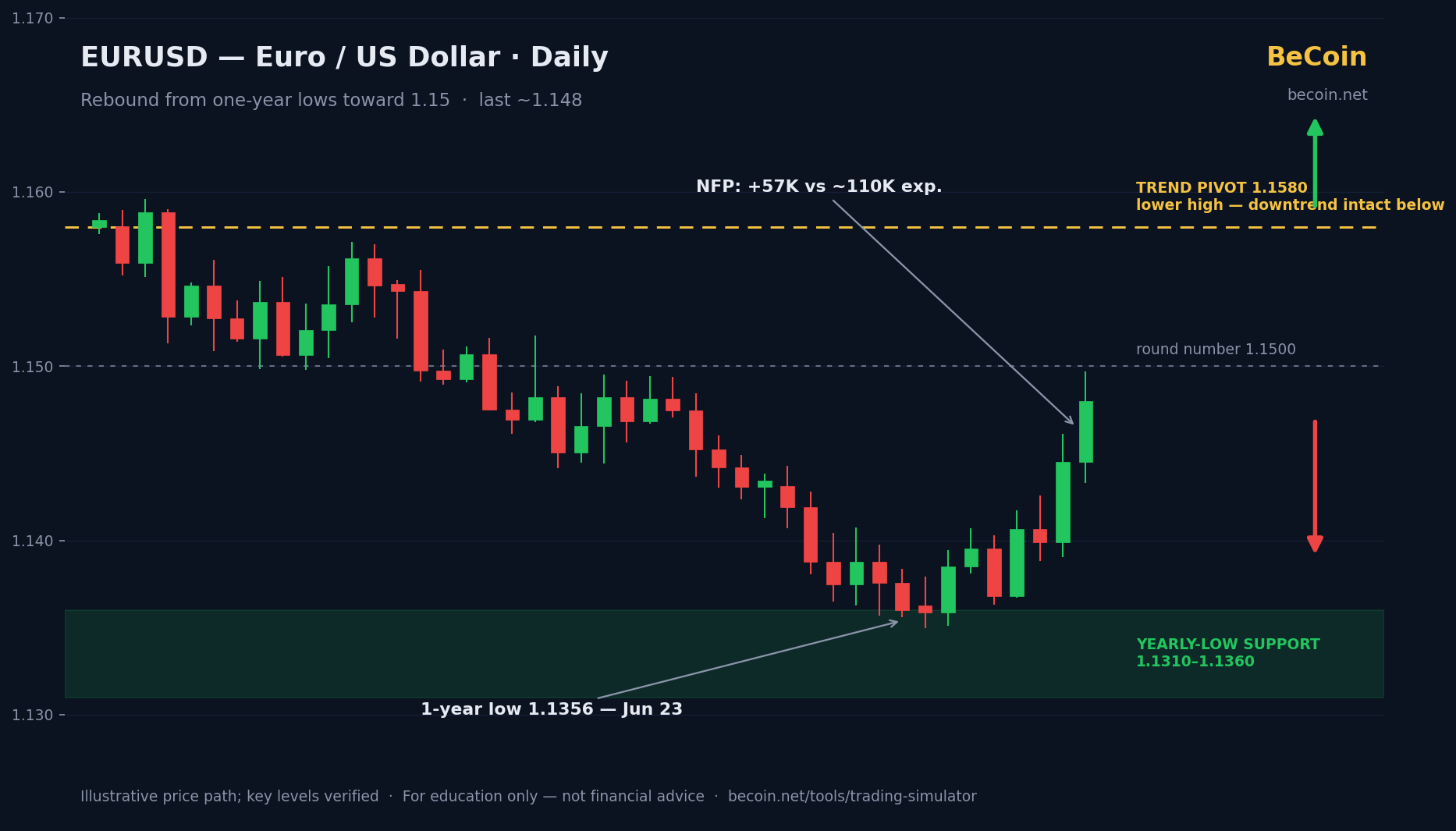
EURUSD bounced from its 1.1356 yearly low toward 1.15 after a weak US jobs report. We map the 1.1580 trend pivot, both scenarios, and what decides whether the dollar's run is over.
Ethereum at Yearly Lows: Accumulation Zone or Value Trap?
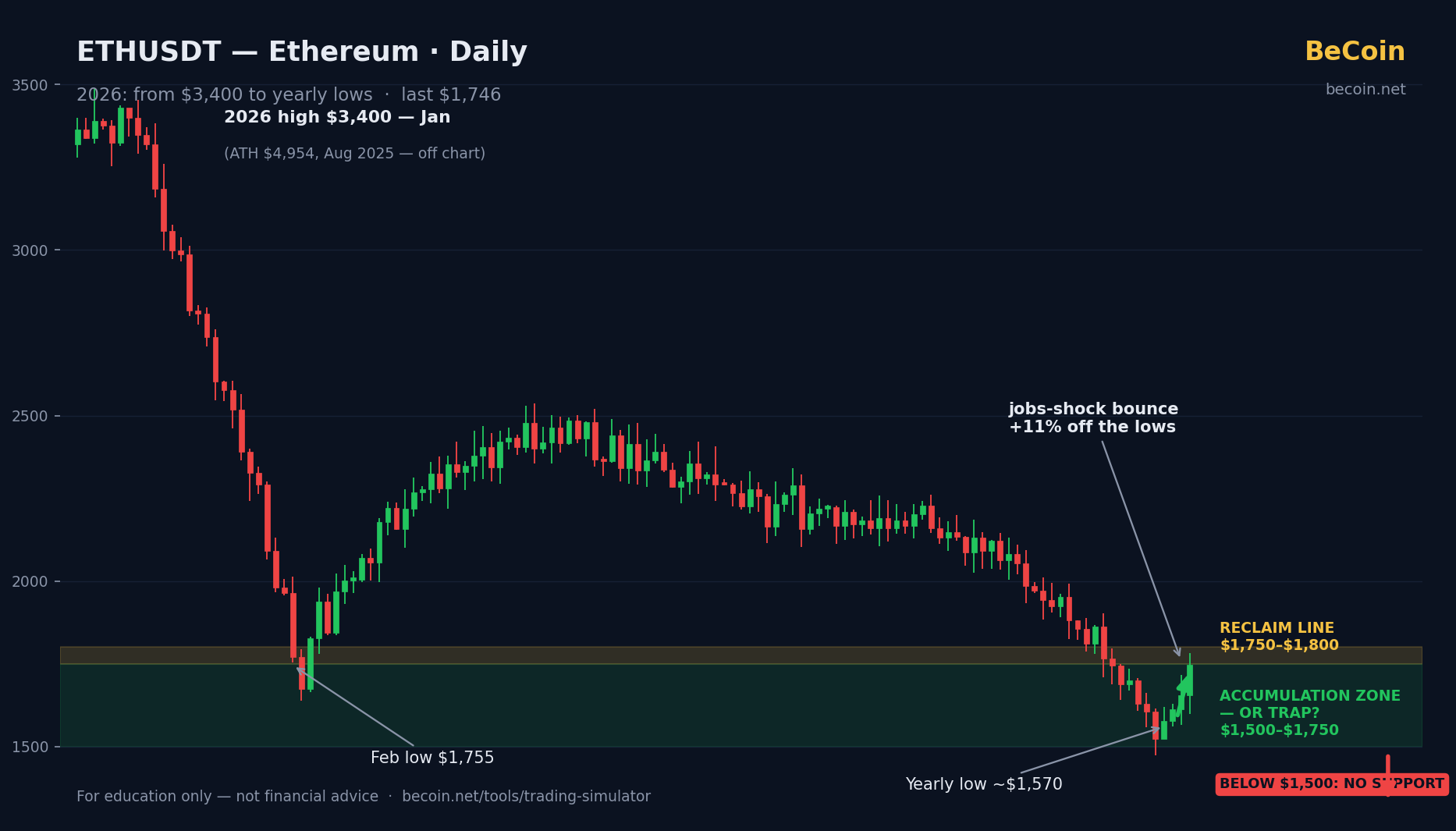
ETH bounced off yearly lows near $1,570 to $1,746 after the US jobs shock, still ~65% below its all-time high. We weigh the accumulation case against the value-trap case, level by level.
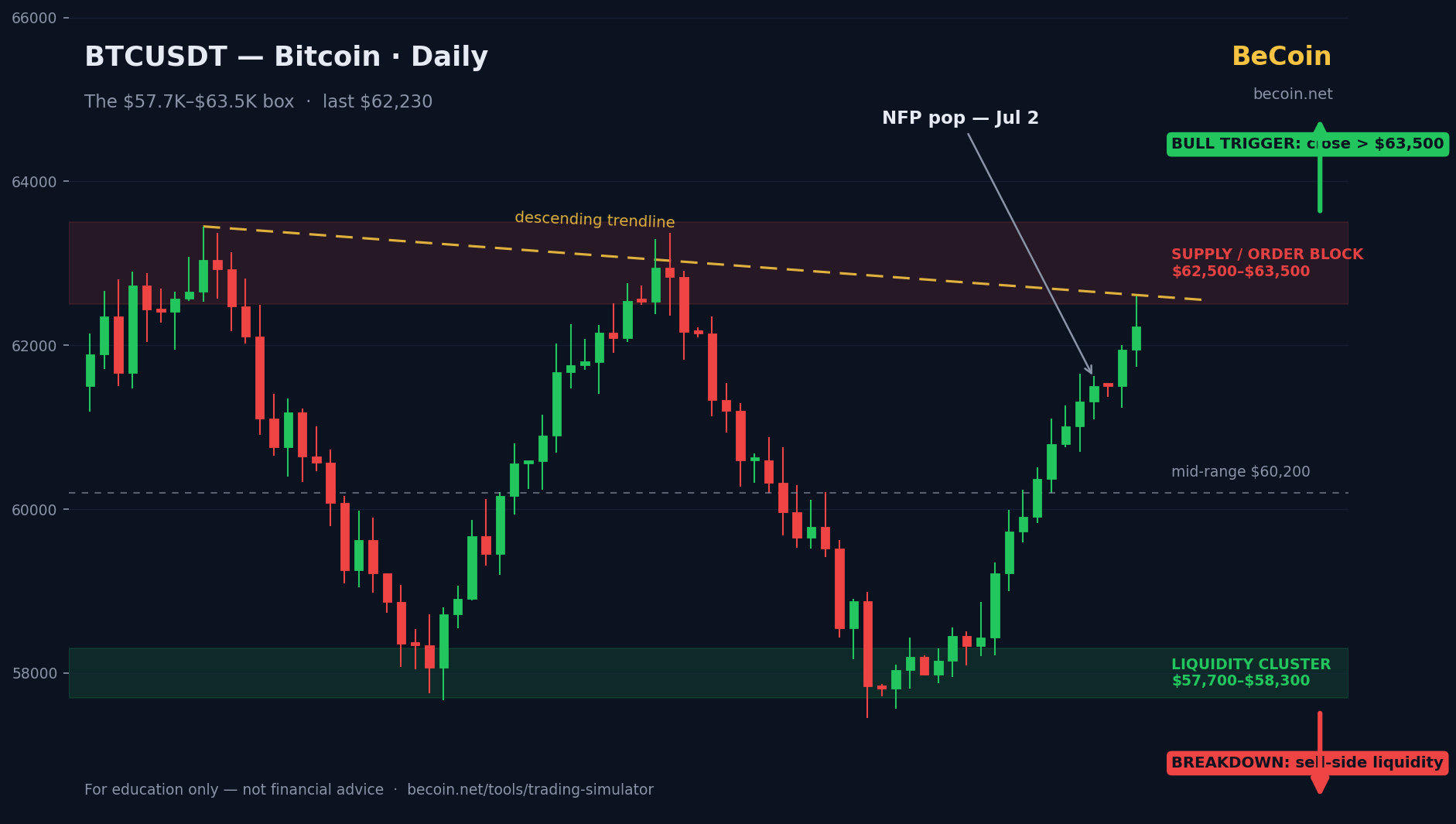
Bitcoin's $6,000 Box: The Levels Both Bulls and Bears Are Watching
Bitcoin is trading near $62K inside a $6,000 range both sides are watching. We break down the supply zone, the liquidity cluster below, both scenarios, and what confirms a real breakout.
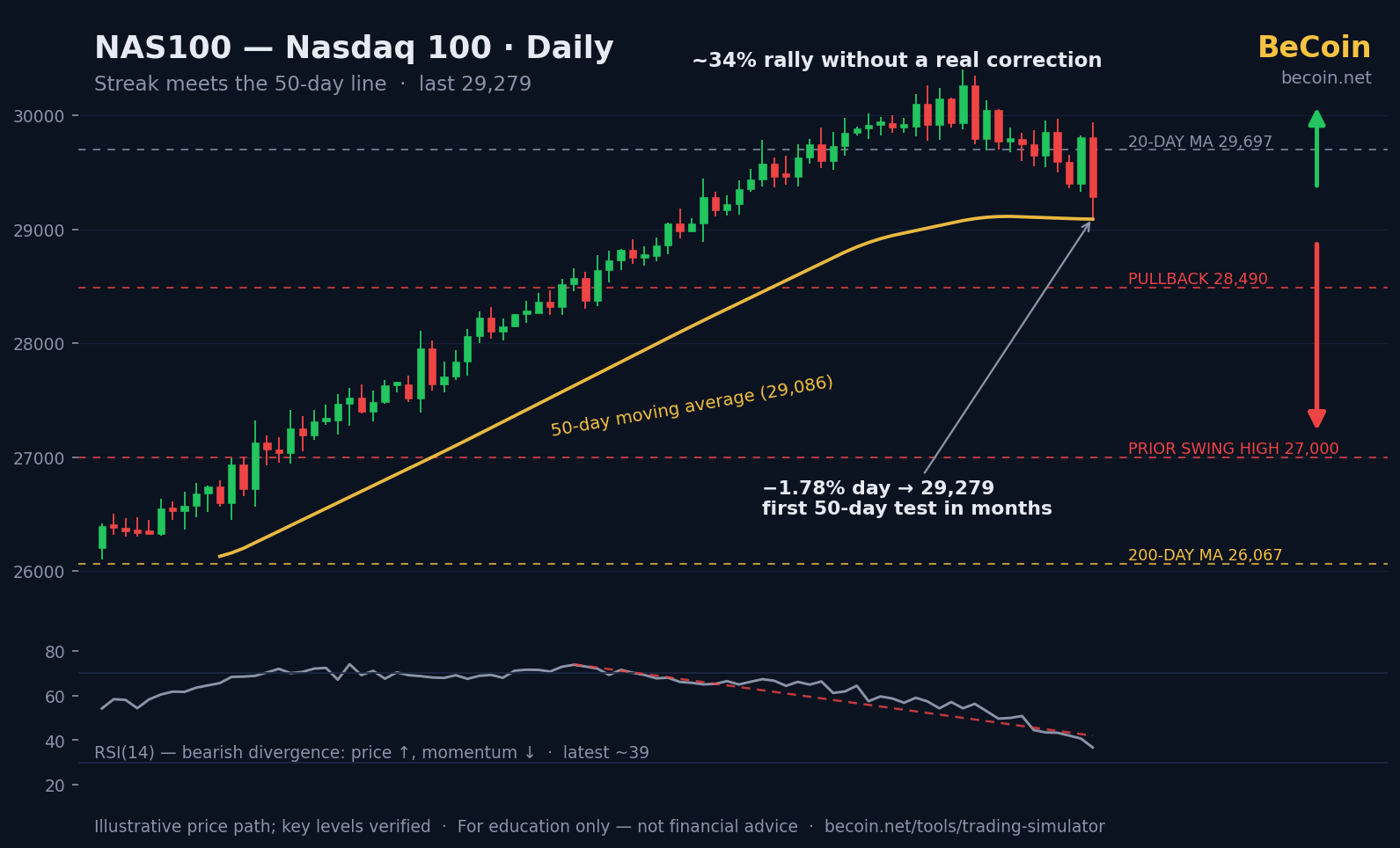
The Nasdaq's Relentless Rally Meets Its First Real Test
The Nasdaq 100 slipped to ~29,279, testing its 50-day average as chips sink and RSI diverges — while rate-cut hopes build. Key levels from 29,697 down to the 200-day at 26,067.
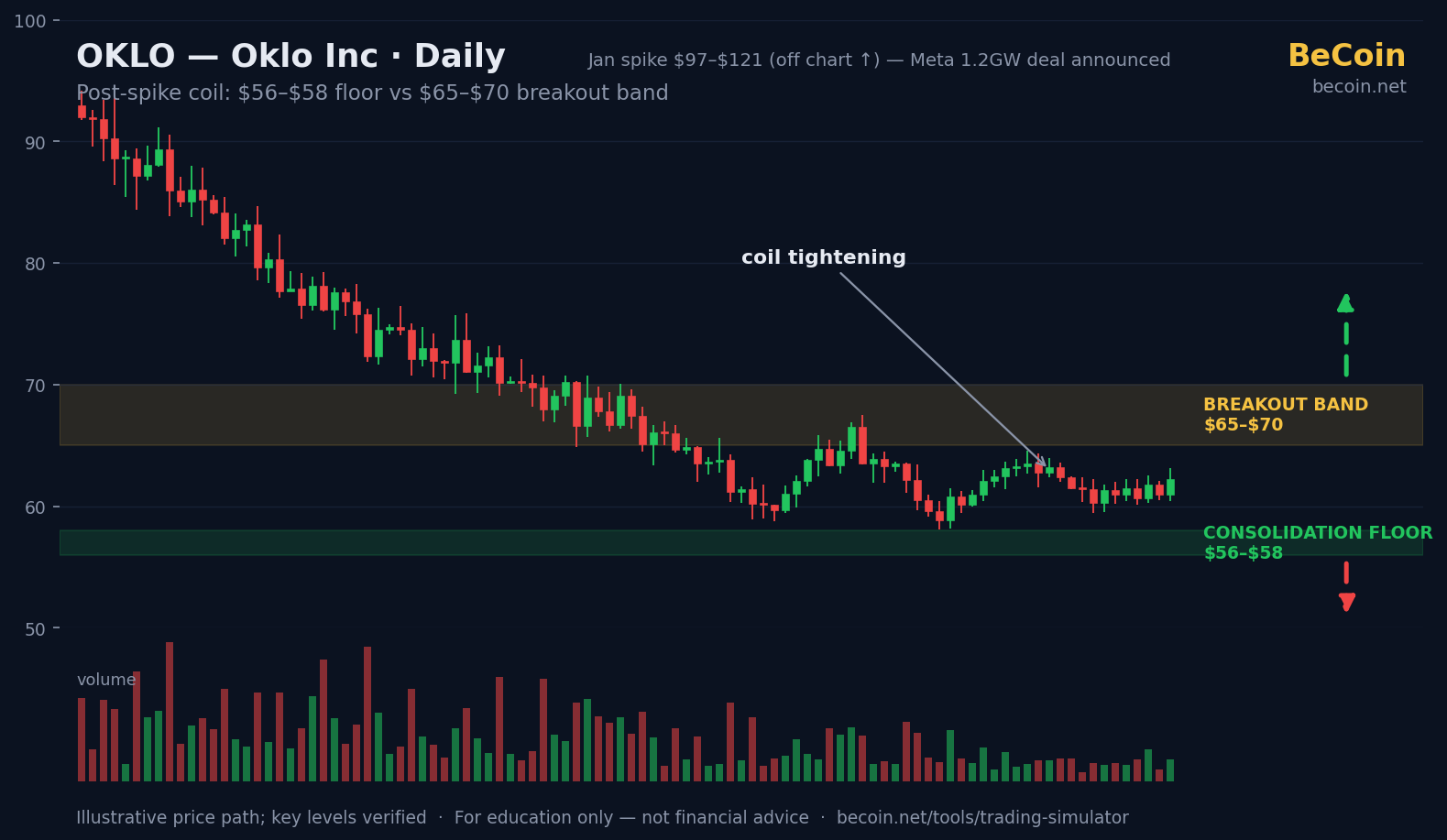
Oklo and the AI Power Trade: A Coiled Chart Meets a Hot Narrative
Oklo's Meta-backed 1.2GW nuclear deal validated the story, but the stock halved from January's spike into a tight $56–$70 range. We map the coil, both cases, and the breakout triggers.